Between tongues: n Afrikaans, English, and academic insecurity
A personal reflection on shifting from Afrikaans to English as an academic voice, the role of AI in easing that transition, and the empathy it’s sparked for students facing similar language challenges.
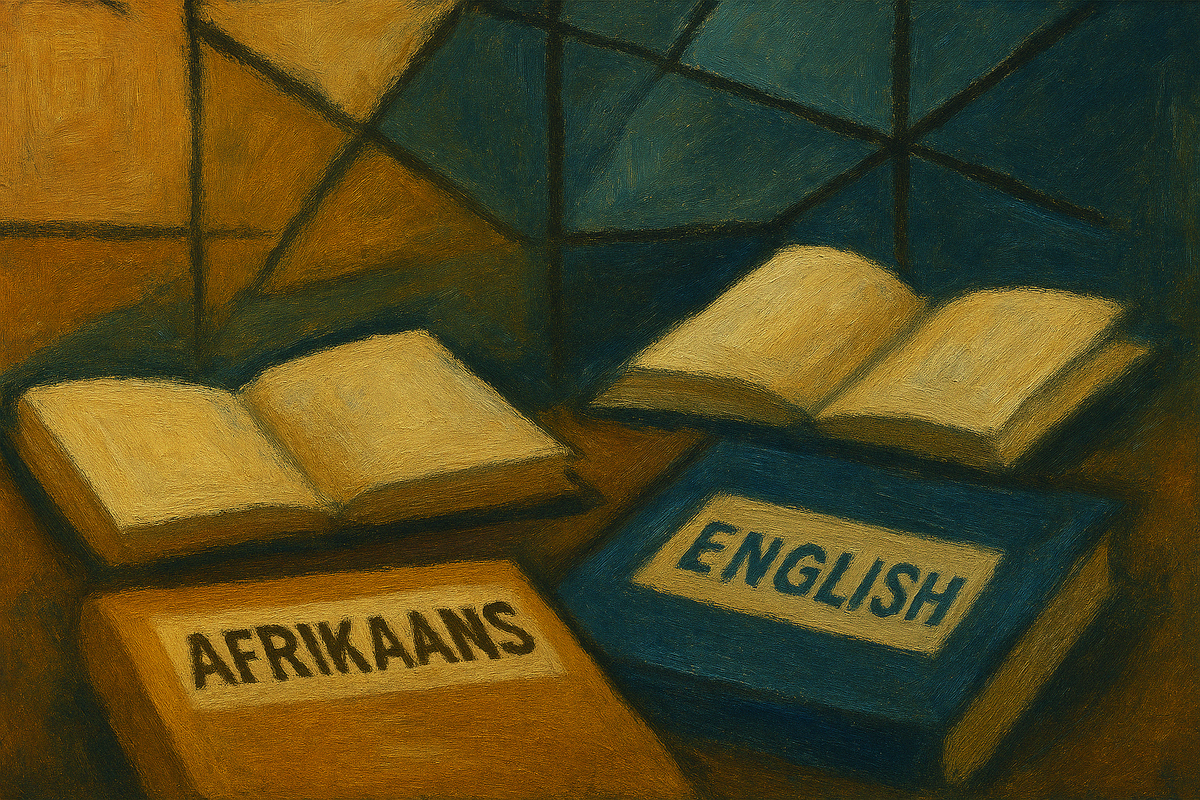
My academic roots are in Afrikaans. I hold an Honours degree in Afrikaans and Dutch, and although I studied English as well, I completed my tertiary studies at an Afrikaans university—meaning every lecture, every academic debate, every footnote, happened in Afrikaans. It’s the language of my intellectual formation.
I used to think I was fully bilingual. But when I moved to China to teach, that illusion cracked. I quickly realized there was no time to learn Chinese—not yet, at least—because I first had to learn how to say complex things in English. Properly.
As a high school literature teacher, I interact more with formal English, but the majority of my work has been in language acquisition. And language acquisition, while rich and valuable, is far removed from the kind of academic English demanded by postgraduate studies.
I think that’s one of the reasons I put off pursuing a Master's in English for so long. It wasn’t just life, or indecision, or the lack of a compelling research question (though all of that played a part). It was a quieter insecurity: the feeling that I couldn’t express myself in English with the same depth, clarity, or nuance that I could in Afrikaans. Not in a way that a Master’s thesis would demand.
Then came AI. I use it—carefully and ethically—as a language and editing tool (see separate post). For the first time, I’m no longer as intimidated by the act of writing in English. My voice doesn’t feel lost in translation. I’ve also learned more about writing in English in the last few weeks than I had in years.
But the ghosts of doubt still linger. Recently, I reread Chapter 1 of Genette’s Palimpsests (1979)—a theoretical cornerstone for my thesis on intertextuality. It took two reads to get what I needed from it. The first read left me stunned by how little I seemed to grasp. It was humbling. Embarrassing, even.
And yet, the very next day, I read an article—an extract from a Master’s thesis by Schutte (1981)—on Die Keiser, an Afrikaans play that forms part of my own Master’s project. Within minutes, I had slotted it into my argument and written two strong paragraphs about it. In Afrikaans. That moment was bittersweet:
- I realized that though my language ability feels subpar, my thoughts and arguments are not.
- I felt an ache of sadness. I don’t write like that in English. Not yet. And I wonder: will my own English writing ever stand tall without heavy scaffolding?
My students—IB English B learners—face similar battles. They’re incredibly intelligent, astute thinkers. Yet they’re held back, constantly, by the limits of language. They often tell me how frustrating it is to know what they want to say, only to find the words won’t come—especially during timed, handwritten exams.
Even with typed assignments like their Extended Essays, where the tools to help their language come across better are right there, many are too afraid to use AI tools for fear of being accused of dishonesty. So, their thoughts remain limited by their language ability.
And then there’s bias. Let’s not pretend we don’t judge writing by fluency. Even the most mindful examiners will struggle to appreciate sophisticated ideas buried under tangled syntax and flat vocabulary.
Sometimes their fears and anxiety (and looming deadlines) get the better of them and they use generative AI. But I understand the temptation. After all, I use these tools myself—not to generate ideas, but to refine and translate them into publishable English. The line between help and substitution is blurry, especially when your thoughts outpace your grammar. I've seen their prompts, I’ve seen their outputs—and often, what they submit is their own intellectual work, just wearing a sharper coat. But in my role, I can’t allow that. Learning demands evidence of the learner's effort, unpolished as it may be.
So yes—I feel for them. Deeply.
And I feel for myself, too. I miss Afrikaans as an academic voice. Actually, I miss it, period. It’s my home language. It’s such a lekker language, so textured and precise. I hope this thesis journey will eventually open doors to contribute academically in my mother tongue again. Perhaps not in this degree, but one day.
In the meantime, I keep reading, keep writing, and keep trying. And maybe —just maybe — one day that will be enough.
Note: For this post, too, I was able to refine my English phrasing while preserving the integrity of my ideas with the support of the AI tool, ChatGPT (OpenAI, 2025).
Works mentioned:
Genette, G., 1997. Palimpsests: Literature in the Second Degree. Translated by C. Newman and C. Doubinsky. Lincoln: University of Nebraska Press.
Schutte, N., 1981. Die Keiser (Bartho Smit). Literator, 2(1), pp.11–22. Available at: https://literator.org.za/index.php/literator/article/view/992 [Accessed 9 Apr. 2025].