The texts behind the thesis
1. Hans Christian Andersen – The Emperor’s New Clothes (1837)
Originally published in Danish, this short story follows an emperor obsessed with his wardrobe. Two swindlers arrive and offer to make him a set of clothes using fabric that is invisible to anyone who is unfit for their position or unusually stupid. Not wanting to be thought incompetent, the emperor pretends to see the clothes—and so do his ministers, advisors, and citizens.
The emperor parades through the city, supposedly wearing his new outfit. No one dares speak the truth until a child, too innocent to understand the social rules, cries out that the emperor is wearing nothing at all.
 A translation of Hans Christian Andersen’s “Keiserens nye Klæder” by Jean Hersholt. Info & links
2. Mark Dunn – Ella Minnow Pea (2001)
This novel is written as a series of letters exchanged between residents of the fictional island of Nollop, named after the supposed creator of the sentence “The quick brown fox jumps over the lazy dog.” When letters from this pangram begin falling off the memorial statue dedicated to Nevin Nollop, the island’s governing council interprets it as a sign from beyond. They begin banning the use of each fallen letter from both speech and writing.
As more letters are removed, communication becomes increasingly difficult, and citizens are punished or exiled for noncompliance. The community deteriorates into fear, surveillance, and forced silence. Eventually, a group of young people work secretly to find a replacement pangram, hoping to prove that Nollop’s sentence is not divinely unique.
The novel is notable for its constrained writing style: as each letter is banned, Dunn omits it from the text, making the narrative an allegorical and literal representation of censorship. The book explores themes of language, authority, self-censorship, and how communities respond to ideological pressure.
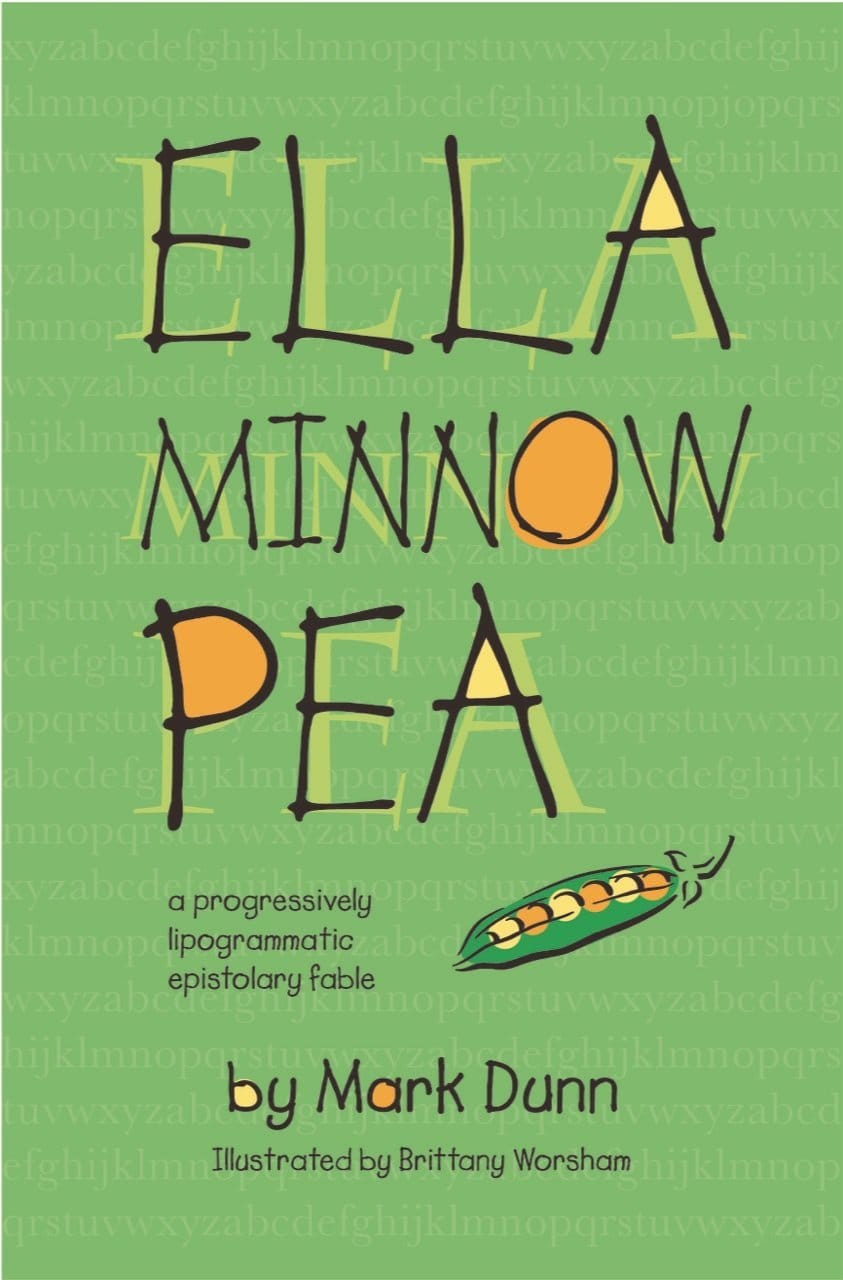
🔗 Learn more about Ella Minnow Pea on Goodreads
🔗 Information for teachers and students on LitCharts
 Mark Dunn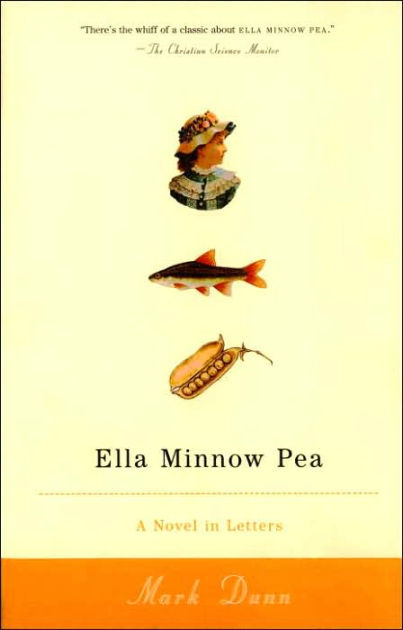
 LitCharts
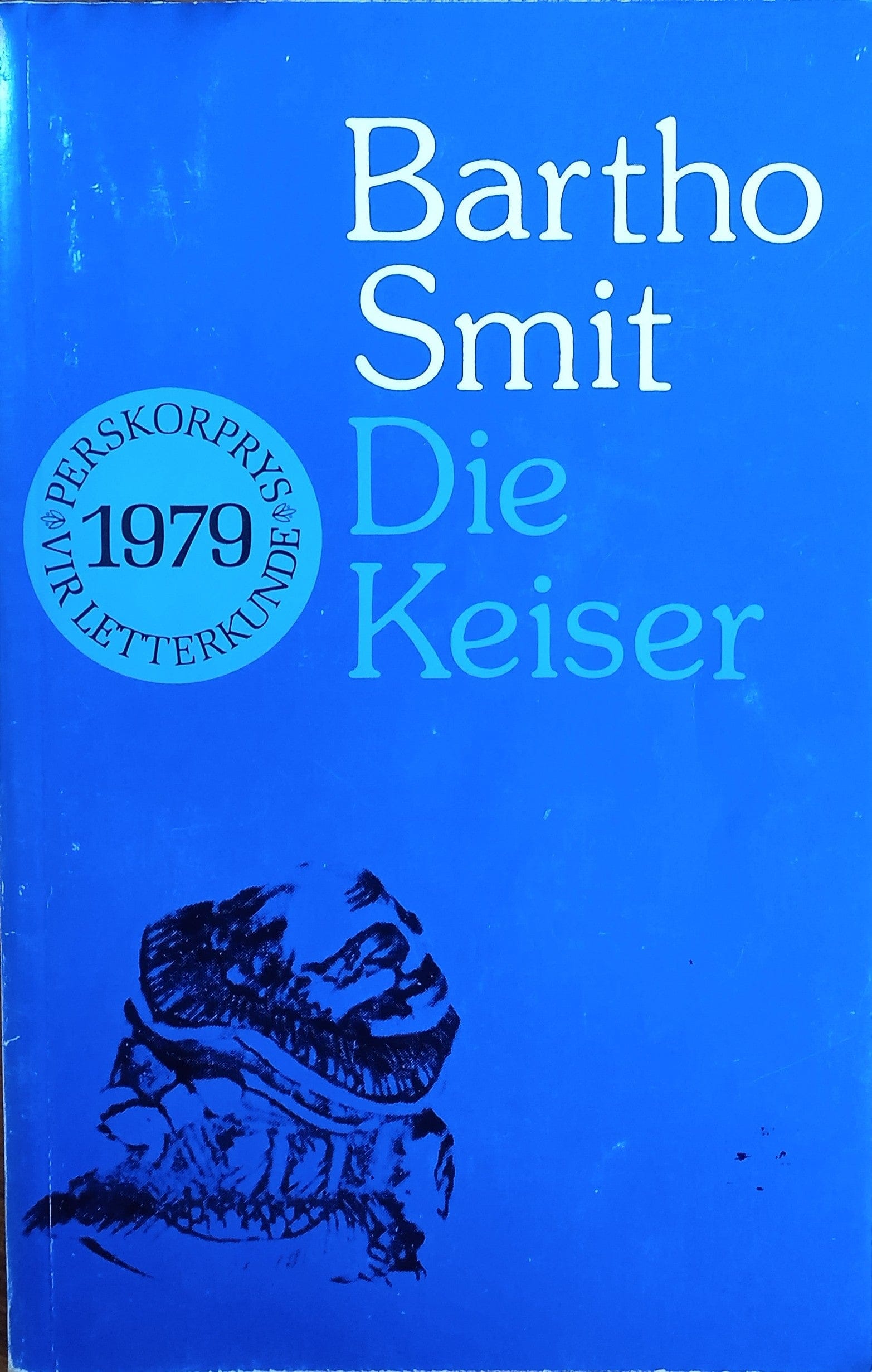
3. Bartho Smit – Die Keiser: Variasies op 'n sprokie van Hans Andersen (1977)
This one-act play, written in Afrikaans during the apartheid era, is a theatrical adaptation of Andersen’s fable. It features a stylized court where characters perform roles based on power, obedience, and illusion. The emperor is surrounded by officials who speak in rehearsed formalities and evasions, unwilling to question anything for fear of appearing unworthy.
Two “weavers” arrive and claim to produce clothing that is invisible to those who are stupid or incompetent. The emperor, desperate to appear enlightened, pretends to see the clothes—and so do his courtiers. Eventually, he parades before the public in his invisible garments. The play ends in ambiguity—without catharsis or resolution—highlighting the persistent fear of truth and the theatrical nature of power.
Using elliptical dialogue, repetition, and deliberate abstraction, Smit critiques the mechanisms of complicity and institutionalized silence. The play reflects the fear-based performance of obedience in politically repressive systems and invites interpretation beyond its immediate setting.
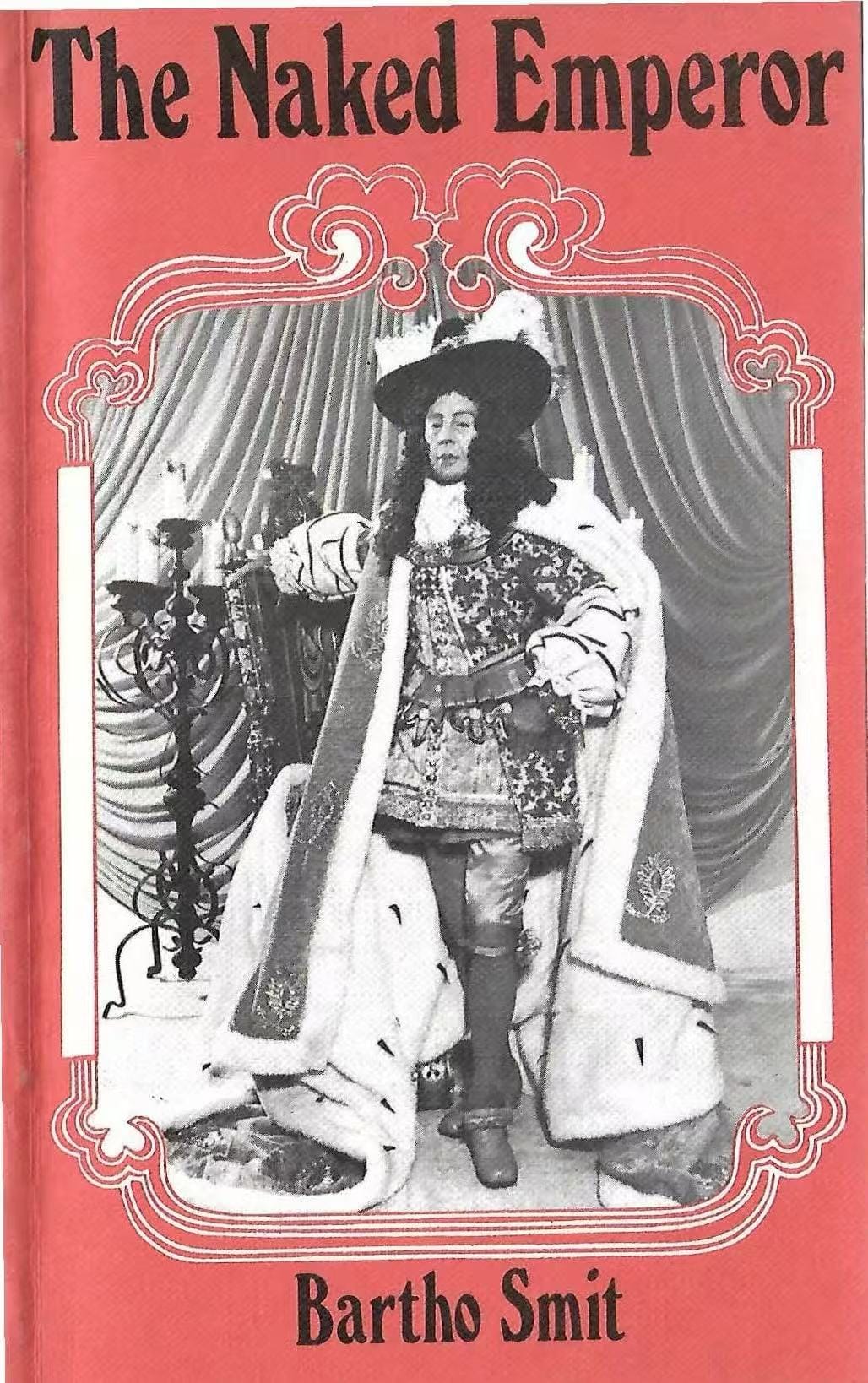
Note: I will be using the English translation and, The Naked Emperor (1982), and consult the Afrikaans version when needed.
- English Title: The Naked Emperor: Variations on a Fairy Tale by Hans Andersen
- Translators: Aart de Villiers and Don Lamprecht
- Published: 1982 by Perskor
- Original Afrikaans Publication: 1977 by Perskor
- First Performance (Afrikaans): 1978 by PACT (Performing Arts Council of the Transvaal), directed by Francois Swart
- Notable Recognition: Winner of the Perskor Prize in 1979
 Contributors to Wikimedia projects


Bibliography
- Andersen, H.C., 1949. The Emperor’s New Clothes. Translated by J. Hersholt. [online] The Hans Christian Andersen Centre. Available at: https://andersen.sdu.dk/vaerk/hersholt/TheEmperorsNewClothes_e.html [Accessed 14 Apr. 2025].
- Dunn, M., 2001. Ella Minnow Pea: A Novel in Letters. San Francisco: MacAdam/Cage.
- Smit, B., 1977. Die Keiser: Variasies op ’n sprokie van Hans Andersen. Johannesburg: Perskor. (Read in English translation: The Naked Emperor, trans. A. de Villiers and D. Lamprecht, 1982)
Note: This post was written entirely by a generative AI tool, as it is a mere introduction to the primary texts of my project.
Cited AI Tool: OpenAI, 2024. ChatGPT (GPT-4), chat.openai.com.